Sunday, January 17, 2010
Moebius Strip Bach Canon
A little MatheMusical fun for Sunday.
via BoingBoing Bach canon played as a moebius strip - Boing Boing

Monday, January 11, 2010
Fun With Dimensional Analysis
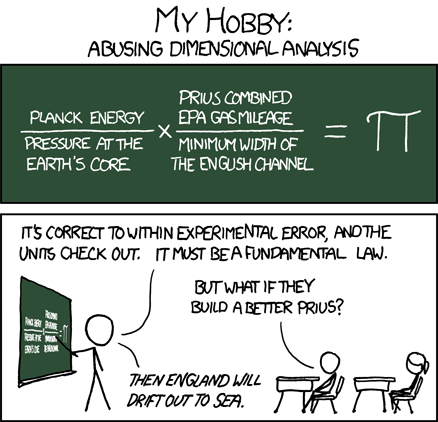
It's amazing what you can do if you can just get the units to cancel.
Monday, December 28, 2009
Sugary Antifreeze Molecule Found In Alaskan Beetle

I've been visiting family out of town - we got here just in time to be snowed-in for Christmas. So I thought some wintry chemistry would be appropriate.
Slashdot recently had a listing about a new anti-freeze molecule that has recently been found in the Alaskan beetle, Upis ceramboides. Anti-freeze molecules have been observed in a variety of plants and animals that help them resist damage from the formation of ice crystals in their tissues. All previous anti-freeze molecules have been proteins, but this new one is a sugar. It may also have a lipid component, but that isn't clear.

The sugar, xylomannan, is a polymer of mannose and xylose. Originally the researchers assumed that the anti-freeze compound in their beetles was a protein, like other known anti-freeze compounds. However they couldn't visualize it with electrophoresis, and the UV-vis and NMR spectra didn't show any sign of peptide bonds or aromatic sidechains like tyrosine or phenylalanine. Instead, the NMR was consistent with a sugar molecule, which was confirmed by GC/MS.
Research Article: A nonprotein thermal hysteresis-producing xylomannan antifreeze in the freeze-tolerant Alaskan beetle Upis ceramboides
Slashdot Science Story | New Antifreeze Molecule Isolated In Alaskan Beetle
Slashdot recently had a listing about a new anti-freeze molecule that has recently been found in the Alaskan beetle, Upis ceramboides. Anti-freeze molecules have been observed in a variety of plants and animals that help them resist damage from the formation of ice crystals in their tissues. All previous anti-freeze molecules have been proteins, but this new one is a sugar. It may also have a lipid component, but that isn't clear.

Research Article: A nonprotein thermal hysteresis-producing xylomannan antifreeze in the freeze-tolerant Alaskan beetle Upis ceramboides
Friday, December 25, 2009
Blondie Christmas Carol
A little Christmas music before going back to some cool chemistry.
Via Blondie - We Three Kings Music Video (2009) Boing Boing
Via Blondie - We Three Kings Music Video (2009) Boing Boing
Thursday, December 24, 2009
Atomic Cookies
I've been away for a while. Here's a little treat for the holidays:


Courtesy of Not So Humble Pie, a cooking blog that has been posting recipes for science themed treats recently.
Via Not So Humble Pie: Science Cookies: Atom
Saturday, November 7, 2009
Blue Sun

The Astronomy Picture of the Day site has this cool image of the sun. The visible spectrum of hydrogen has 4 lines called the Balmer Series. I can see at least three of them myself, but the fourth is on the edge of my eyesight. To me the lines have the colors Red (656 nm), Blue (486 nm), Violet (434 nm) and Violet (410). This picture was take using a filter that only lets through the Hydrogen Alpha line, and then color inverted to appear blue. I'm not sure why they changed the color, but it looks cool. Take a look at the larger version of this picture at the link.
Image Credit & Copyright: Alan Friedman (Averted Imagination)
Link APOD: 2009 November 4 - Blue Sun Bristling
Sunday, November 1, 2009
Guitar Duet with only One Guitar
This looks a little awkward, but the amazing thing is that some times his left hand is fretting the strings that she is playing, and she is fretting the strings that he is playing. When I play, both hands are working in synch - I would think it would be hard to NOT have both hands playing the same strings.
via Neatorama
Subscribe to:
Posts (Atom)

 Posts
Posts


